How to Trade Meme Coins With a Tiny $10 Portfolio Without Fees Eating You Alive
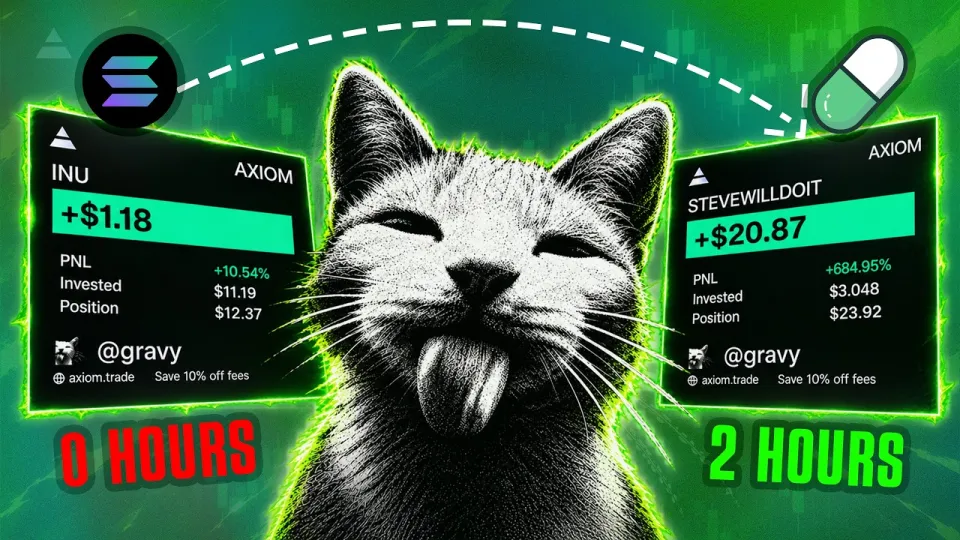
Video: I Tried Trading Memecoins with Just $10
Want articles like this for your own video to promote it on YouTube and Google? Order them through the Telegram bot @sat_sit_bot. The bot writes and publishes the articles itself (with your YouTube video embedded) on popular topical websites (no ads). Free trial — 50 articles.
· based on the channel gravy
Key takeaways
- Five real trades were made with buys capped at 0.05 SOL each — roughly $10 per position on Solana.
- Tickers traded: STEVEWILLDOIT, NPC, MET (Meteora), PUMPY the Trader and UNTXD.
- Trades ran through Axiom, which advertises 2x cashback and 15% lower fees via referral.
- The X Money coin meta was driven by the e/acc and Cream narrative cycle.
- The creator's own weak spot was exit timing — one trade was fumbled badly.
- Next step proposed in the video: a live session starting from 0.1 SOL.
You can trade meme coins with $10, but only if position size, fees and exit rules are set before you click buy. In practice that means buys of 0.05 SOL or less on Solana, one narrative per trade, and selling into strength instead of hoping for a second leg. The channel gravy tested exactly this with five live trades through Axiom, the trading terminal whose referral link gives 2x cashback and 15% lower fees.
What $10 actually buys you in meme coin trading
A $10 bankroll is not a smaller version of a $1,000 account — it is a different game with different math. On Solana, a swap costs a fraction of a cent in network fees, but the real cost is the pool fee plus slippage, and both scale with how thin the token is. A 0.05 SOL buy into a fresh pump.fun launch can lose 5–10% of its value to spread and price impact before the chart even moves.
The workable rules for a micro portfolio look like this:
- Cap each buy at 0.05 SOL so a total loss never removes more than one position from the book.
- Only trade tokens with enough liquidity that a $10 exit does not crater the price — thin books punish small sellers as hard as big ones.
- Count the round trip: entry fee, exit fee, priority fee and slippage. If the expected move is under 20%, the trade is not worth the friction.
- Treat every position as expendable. With five shots at $10 each, the plan is to let one or two runners pay for the four that die.
That is the honest answer to whether a small portfolio can trade memecoins: yes, but the edge has to come from picking narratives, not from position sizing.
The five trades and the narratives behind them
The video walks through five positions, each chosen for a specific story rather than a chart pattern. STEVEWILLDOIT is the purest example of a meme coin built on a single viral phrase — it lives or dies on whether the joke keeps circulating. NPC followed the same logic in a different key, riding the broader "NPC" internet meme that keeps resurfacing across crypto and social feeds.
MET, shorthand for Meteora, is a different category: a token tied to a real Solana product with an existing user base, which gives it a floor that pure jokes do not have. PUMPY the Trader leaned on the pump.fun ecosystem itself — a meta-token about the launchpad everyone was already using. UNTXD closed the set with a narrative that had less obvious staying power.
The lesson across all five is that the ticker matters less than the story attached to it. A meme coin with a name nobody can explain in one sentence has no distribution, and without distribution there is no second buyer.
Why the X Money coin meta ran
The X Money coin cycle is the clearest case study in the video of how a meta forms and fades. The narrative combined two ingredients: the e/acc (effective accelerationism) crowd, which pushes anything framed as technology moving faster than regulation, and the Cream storyline that circulated alongside it. Together they gave traders a ready-made story about payments, social platforms and crypto converging.
Metas like this behave predictably. First comes the idea, then the first token, then a wave of copycats with worse names and thinner liquidity. The money is made in the first phase, when the story is new and the chart is small. By the time a meta has a dozen derivatives, the easy percentage moves are gone and the remaining upside belongs to whoever exits first.
The mistake that cost the most
The one trade the creator openly calls a fumble is the most useful part of the breakdown. The pattern is familiar: a position goes green, the trader holds for a bigger move, the narrative cools, and the exit happens after the momentum is gone. With a $10 book there is no room for that kind of patience — a 30% gain on 0.05 SOL is a few cents, but a 60% drawdown means the next four trades start from a smaller base.
Practical exit rules for small accounts:
- Sell a portion into the first strong spike instead of waiting for a second one.
- Set a hard invalidation level before entry and honour it without renegotiating.
- If the narrative stops producing new posts and new buyers, the trade is over regardless of price.
Common questions from small-account traders
Small portfolios generate their own set of doubts, and they repeat across every comment section under videos like this one.
The most common is how anyone keeps up with narratives at all — reading every post, remembering who has influence, tracking which account started a trend. The realistic answer is to narrow the funnel: follow a small list of accounts that consistently surface ideas early, and ignore everything else. Depth on ten sources beats shallow coverage of a hundred.
The second recurring complaint is buying the dip and watching it never recover. That usually means the dip was not a dip but the end of the move — in meme coins, a 40% pullback after a vertical run is often distribution, not a discount. Selling into a loss and then watching the token run higher later is the same error in reverse: the exit was right for the information available, and the later move belonged to a different trade.
The third is arithmetic. A 20–40% loss on a micro position feels trivial in dollars, which is exactly why it gets ignored — until five of them compound into a portfolio that can no longer take a real shot. Tracking total profit and loss, not just the wins, is the only way to know whether the strategy works.
Useful links
- Axiom trading terminal with referral bonus and reduced fees: https://axiom.trade/@gravy
- The Trenches Discord: https://discord.gg/W7TqkExcSd
- Free Axiom imports and trade signals (NFA): https://discord.gg/9W5j3XUgYB
- Creator's X account: https://x.com/gravyski
- Leverage trading with 20% futures fee reduction: https://www.bitbase.com/landing-page/trading-earning-Gra?ref=8CYOGY
Bottom line
Trading meme coins with $10 is possible, but it is a discipline test rather than a money-making plan: cap buys at 0.05 SOL, pick tokens with a one-sentence story, and exit into strength. The five trades in gravy's experiment show that narrative selection is the real skill and that exit timing is where small accounts bleed. Anyone starting with a micro bankroll should assume most positions go to zero and treat the occasional runner as the entire return. The full walkthrough, including the trade the creator admits fumbling, is on the gravy channel — and the same referral link, Axiom registration with cashback, is where the trades were executed.
Questions & answers
Can you really trade meme coins with only $10?
Yes, technically — the network fees on Solana are negligible and a 0.05 SOL buy is enough to enter most liquid tokens. The constraint is not the entry but the exit: slippage and pool fees eat a larger share of a tiny position, so you need a move of at least 20% just to make the trade worthwhile.
How do you keep up with meme coin narratives without drowning in information?
Narrow your sources instead of widening them. Follow a short list of accounts that consistently surface ideas early, and skip everything else. Depth on a handful of voices beats trying to read every post and remember every influencer.
Why does buying the dip usually fail in meme coins?
A sharp pullback after a vertical run is often distribution rather than a discount. When the narrative has already peaked, the sellers are the people who bought earliest, and there is no fresh buyer base to push the price back up. Buying that dip means buying the exit liquidity of others.
Should a beginner start with 0.1 SOL or 1 SOL?
Start with the amount you can lose entirely without changing your finances, which for most beginners is closer to 0.1 SOL. A smaller bankroll forces position discipline and makes fee drag visible, and it lets you learn exit timing before real money is at stake.
Source: I Tried Trading Memecoins with Just $10 · Markdown version