7 Steps to a Successful Prop Firm Trading Strategy
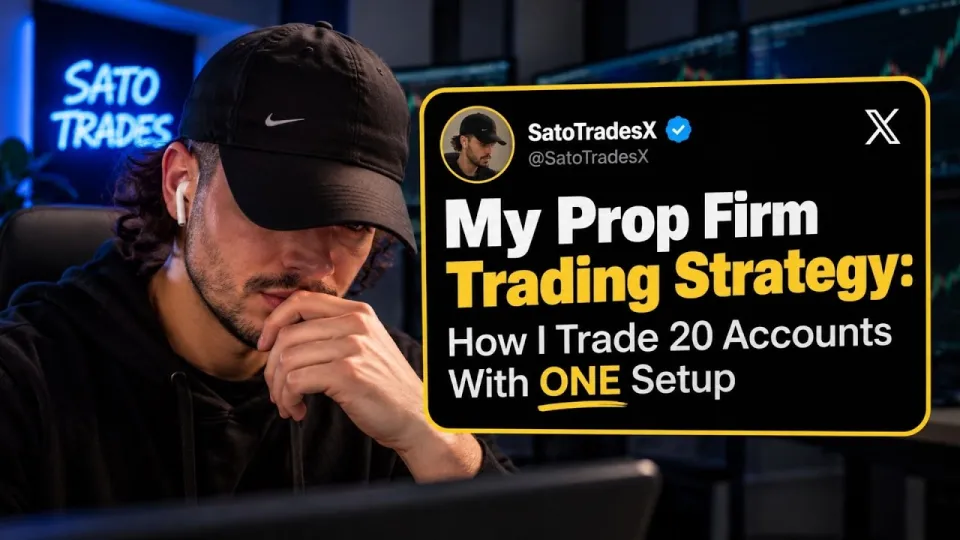
Video: Prop Firm Trading Strategy: How to Pass a Funded Challenge in 2026
· based on the channel Sato Trades
Key takeaways
- Prop firm trading requires a mechanical strategy for funded challenge success
- Using 1-minute futures charts (ES & NQ) improves entry timing
- Strict risk management protects your funded account from drawdowns
- Scaling accounts and using trade copiers multiply payout potential
- Daily levels and market structure analysis are key to trade selection
Prop firm trading strategy demands a precise, mechanical approach to consistently pass funded challenges and secure payouts. This method primarily uses futures trading on 1-minute charts to identify high-probability entry points and applies strict risk management to protect capital.
Understanding Prop Firm Trading Strategy
A prop firm trading strategy focuses on passing evaluation phases by demonstrating consistent profitability under specific risk limits. The core is a mechanical trading system based on clear rules rather than discretionary decisions. This strategy targets futures markets, specifically the E-mini S&P 500 (ES) and Nasdaq (NQ) contracts, using intraday price levels to find entries.
Mapping Daily and Intraday Levels for Trade Entries
Successful prop firm traders mark daily support and resistance levels before the market opens. These levels come from prior day highs, lows, and key order flow zones. Intraday levels are then identified to refine potential longs and shorts.
Traders use tools like TradingView to group, hide, and organize these levels visually for quick reference during live sessions. This organization enhances focus and helps avoid overtrading or confusion.
Using a 1-Minute Chart for Precise Entries
The 1-minute chart allows traders to pinpoint exact entry points with minimal lag. Trading around the marked levels with confluence from price action signals (like pin bars, engulfing candles) increases the probability of successful trades.
Entries are typically made using limit orders placed at or near these levels, combined with predetermined stop losses and take profits. This approach reduces emotional decision-making and enforces discipline.
Risk Management Rules to Protect Your Funded Account
Risk management is critical in prop firm trading strategies. Traders should never risk more than 1% of their account on any single trade. Stop losses must be set immediately with every order, and take profits predefined to lock in gains.
Adhering to these rules prevents large drawdowns that can lead to challenge failure. Consistency in risk limits helps maintain steady growth and qualifies traders for payouts.
When Not to Trade Based on Market Structure
Recognizing unfavorable market conditions is as important as finding entry signals. Traders must avoid trading during unclear market structure phases such as sideways consolidation or low liquidity periods.
Indicators of when not to trade include lack of clear support/resistance, absence of momentum, or conflicting signals across timeframes. Following this discipline improves overall win rates.
Scaling Prop Firm Trading with Multiple Accounts
To maximize funded payouts, some traders manage multiple prop firm accounts simultaneously. Using trade copier software and brokers like Tradovate enables executing identical trades across accounts efficiently.
This strategy requires meticulous record-keeping and risk adherence per account but can significantly increase monthly income from prop trading.
Key Tools and Mentorship for Prop Firm Success
Utilizing platforms like TradingView for charting and the trade copier service recommended by Sato Trades streamlines the trading process. Mentorship programs that teach level marking, order placement, and market structure analysis accelerate skill development.
Joining communities such as the Sato Trades Discord offers daily level updates, discussions, and peer support which are invaluable for maintaining discipline and motivation.
Useful Links
- Daily ES & NQ levels, bias, and tutorials: https://satotrades.com/vip
- Best futures prop firms full guide: https://satotrades.com/guides/best-futures-prop-firms
- Free Discord for levels discussion and proof: https://discord.gg/Yt5PuQjXRp
- Trade copier software: https://portal.tradecopia.com/signup?via=SATO
Итог
A structured prop firm trading strategy combining daily level analysis, 1-minute chart entries, strict risk management, and clear market conditions helps traders pass funded challenges consistently. Scaling through multiple accounts and leveraging trade copiers can amplify payouts. The channel Sato Trades provides a comprehensive framework and ongoing support that equips traders to treat prop firm trading professionally and achieve their payout goals. For those serious about succeeding, accessing daily levels and mentorship via https://satotrades.com/vip is highly recommended.
Questions & answers
What is the best timeframe to use for prop firm trading entries?
The 1-minute chart is ideal for precise entries in prop firm trading, especially when combined with daily and intraday levels. It allows traders to time limit orders accurately and manage stops effectively.
How much risk should I take per trade during a prop firm challenge?
Risk should be limited to about 1% of the account balance per trade. This protects the funded account from large drawdowns and ensures compliance with most prop firm rules.
Can I trade multiple prop firm accounts at once?
Yes, many traders scale their profits by managing several accounts simultaneously using trade copier software. This requires consistent risk management and order execution across all accounts.
What should I avoid trading during a prop firm evaluation?
Avoid trading when the market structure is unclear, such as during consolidations or low volatility periods. Trading only in favorable conditions with clear support and resistance improves success rates.
Source: Prop Firm Trading Strategy: How to Pass a Funded Challenge in 2026 · Markdown version